

How to Pick the Right Partner for Your Ride-Hailing Startup — Costs, Features & What to Avoid
Why Uber Clone App Development Companies Exist — And Why You Should Care
You have the idea. You see the opportunity. Maybe you live in a city where ride-hailing options are unreliable, pricing is unpredictable, or drivers are hard to find. Or you are an entrepreneur in a mid-size market where Uber and Lyft have never bothered to show up.
So you decide to build your own platform. Then reality hits.
Custom ride-hailing app development costs between $80,000 and $500,000 and takes six to eighteen months to build from scratch, before you factor in GPS infrastructure, payment gateway integration, driver management systems, and the backend architecture to handle concurrent ride requests.
That is where Uber clone app development companies come in. A white-label ride-hailing platform gives you a tested, proven codebase you can brand, configure, and launch in weeks, not months, at a fraction of the cost.
But not every provider is worth your investment. Some are fast but impossible to scale. Others lock you into SaaS dependency models that drain your margins every month. This guide covers the top Uber clone app development companies operating in 2026, what separates them, and exactly what to evaluate before you sign a contract.
The Ride-Hailing Market in 2026: Why the Timing Is Right for a Clone Platform
Before comparing Uber clone app development companies, it helps to understand why this market is accelerating right now.
| Metric | 2026 Data Point |
| U.S. Market Size | $27.97 billion (up from $23.43B in 2025) |
| Global Market Size | $184–$315 billion (varies by source) |
| Active Users Worldwide | 425+ million ride-hailing users |
| App-Based Booking Share | ~87% of all ride-hailing transactions |
| Projected Growth | Double-digit CAGR through 2034 |
What does this mean for a regional or local operator? Demand is real and growing. Riders want alternatives to the duopoly. The window for regional platforms to capture market share before further consolidation is open right now, and the right Uber clone app development company gets you into that window fast.
What Is an Uber Clone App? (And What Should It Include?)
An Uber clone app is a pre-built, white-label ride-hailing software platform that replicates the core functionality of apps like Uber or Lyft. You license or purchase the codebase, apply your branding, configure pricing rules, and launch under your own name.
A production-ready Uber clone should include all of the following out of the box:
- Passenger-facing mobile app (iOS and Android)
- Driver app with navigation and earnings tracking
- Real-time GPS tracking and live map view
- Admin dashboard for fleet, driver, and pricing management
- Payment gateway integration (card, digital wallet, in-app wallet)
- Dynamic surge pricing configuration
- Two-way ratings and reviews for riders and drivers
- Push notifications and ride status updates
- Ride scheduling and fare estimation engine
Advanced Uber clone platforms add:
- AI-powered dispatch and route optimization
- Analytics dashboards with driver performance metrics
- Multi-service support for deliveries or logistics
- Blockchain-based payment systems
- EV fleet management with charging station routing
- Subscription-based ride plan billing
Key Differentiator:
The gap between a good Uber clone and a bad one is not the feature list. It is how well those features hold up at scale, how much you actually control, and whether the development company will still support you 18 months after launch.
Uber Clone vs Custom Development: A Direct Comparison
Before evaluating specific Uber clone app development companies, understand which development approach fits your business model and budget.
| Approach | Cost Range | Time to Launch | Best For |
| White-Label Clone | $5,000–$20,000 | 1–4 weeks | MVPs & lean launches |
| Semi-Custom Clone | $20,000–$80,000 | 2–4 months | Specific feature needs |
| Full Custom Build | $80,000–$500,000+ | 6–18 months | Highly differentiated products |
For most startups and regional operators, a white-label or semi-custom clone is the right choice at launch. Revenue and validated demand come first. Deep customization comes second.
The operators who fail in this space are the ones who over-build before they have proof that the market will pay. Start with what works. Improve what earns money.
Top Uber Clone App Development Companies in 2026
The nine companies below represent the most active and widely recognized providers in the Uber clone development space this year. Match your business model to the right type of provider; that matters more than picking whoever ranks first on Google.
1. Uberclone.co, Best for Rapid, Launch-Ready Deployment
Best For: Startups that need a fully packaged ride-hailing platform with minimal configuration time.
Uberclone.co positions itself as a launch-ready solution for entrepreneurs entering the mobility market. The platform ships with rider and driver apps, a live GPS tracking layer, payment integrations, and an admin dashboard.
Core strength: speed of deployment. If your priority is getting from zero to a working product as fast as possible, this provider is built for that outcome. Customization options exist, but deep feature modification is not their primary offering.
2. Elluminati Inc. Best for Multi-Service On-Demand Platforms
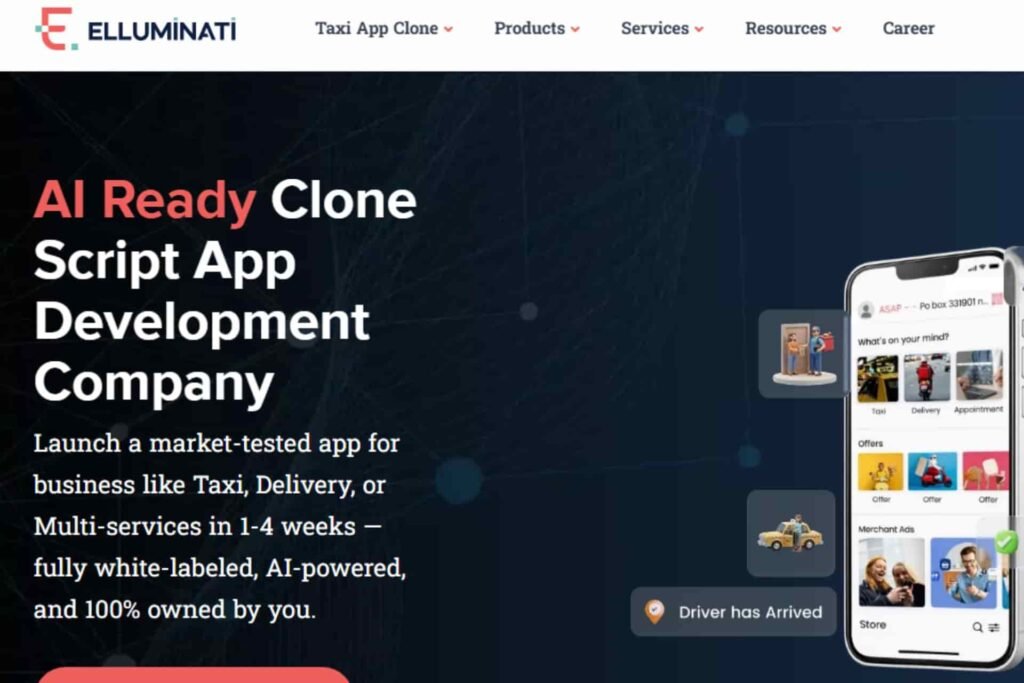
Best For: Businesses that want to run ride-hailing alongside food delivery, parcel logistics, or other on-demand verticals from one backend.
Elluminati’s platform is architected around the idea that mobility is one piece of a larger on-demand business. Their multi-service backend lets operators offer rides, deliveries, and other services through a single platform and admin dashboard.
Their surge pricing and fleet management tools are among the more mature options at this price tier. If your long-term vision is a super app or a multi-vertical operation, Elluminati’s architecture is worth evaluating first.
3. AppDupe, Best for Budget-Conscious Founders Testing a Concept
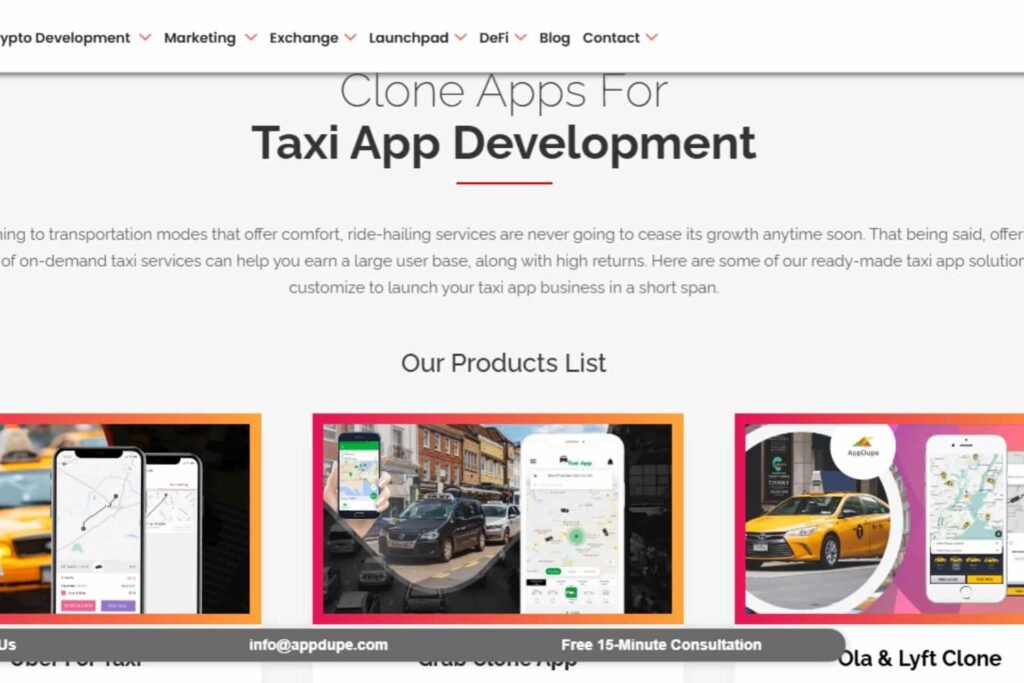
Best For: Founders working with a tight budget who need a working clone script with a fast setup path.
AppDupe operates a large library of clone scripts across multiple app categories, including ride-hailing. Their appeal is in breadth and affordability. They offer both pre-built scripts and lighter custom development options.
This is a solid starting point for entrepreneurs who want to validate a business concept before committing to a larger investment. Trade-off: their platform may require more third-party integrations to reach advanced feature parity.
4. Apptunix, Best for Tailored Clone Development with Custom Logic
Best For: Businesses that want clone-based foundations with meaningful customization on top.
Apptunix occupies the middle ground between pure white-label speed and full custom development. Their team builds ride-sharing solutions that include driver management tools, route planning systems, and cloud-based backend infrastructure.
They attract clients who have specific operational requirements that standard clone scripts cannot meet, but who cannot justify the cost or timeline of a fully custom build. Good fit for operators with defined, non-standard workflows.
5. Suffescom Solutions, Best for Blockchain Payment Integration
Best For: Operators looking for white-label ride-hailing with blockchain payment rails and advanced analytics.
Suffescom offers standard white-label Uber clone services alongside integrations for blockchain-based payments and deep analytics. For operators in markets where decentralized payment infrastructure is relevant or where financial transparency is a business differentiator, their stack is worth examining.
Their white-label turnaround is competitive, and their analytics layer gives operators meaningful visibility into driver performance and revenue trends.
6. Hyperlocal Cloud, Best for On-Demand Marketplace Builders
Best For: Entrepreneurs building on-demand marketplace businesses where ride-hailing is one of several service verticals.
Hyperlocal Cloud is designed for businesses that want to aggregate multiple on-demand services under one platform. Ride-hailing connects into their delivery, logistics, and local services infrastructure.
This is the right choice for operators in hyper-local markets who see value in owning the last-mile experience across multiple service categories — not just transportation.
7. Trioangle Technologies, Best for Multi-Region and International Launches
Best For: Startups planning to launch across multiple regions or countries from day one.
Trioangle produces ride-hailing solutions with a strong emphasis on internationalization. Their platform supports multi-region configurations, multiple currencies, and global deployment assistance for operators not starting in a single market.
Core features include ride scheduling, fare calculation engines, and driver rating systems. Their primary strength is helping operators navigate the operational complexity of launching across different markets simultaneously.
8. Intelivita, Best for Long-Term Scale and Platform Growth
Best For: Businesses building for high user volume with a platform architecture that needs to grow with them.
Intelivita builds ride-sharing platforms with scalability as the primary design constraint. They offer clone-based starting points and fully tailored application development depending on the client’s roadmap.
If your three-year plan involves significant user volume, multiple service lines, or expansion into adjacent markets, Intelivita’s team approaches the engagement with that lens from the first conversation.
9. OpenXcell, Best for Enterprise-Level Development with Long-Term Support
Best For: Enterprise-level organizations that need ride-hailing development paired with long-term technical support contracts.
OpenXcell is a full-service mobile app development firm with a portfolio spanning multiple industries, including ride-hailing. Their work in this space focuses on high-performance, well-designed applications with scalable backend infrastructure.
They appeal most to companies that view their app as a long-term technology investment and need a development partner accountable through multiple product iterations, not just the initial launch.
Uber Clone App Development Companies: Quick Comparison
| Company | Core Strength | Best For |
| Uberclone.co | White-label speed | Startups needing rapid deployment |
| Elluminati Inc. | Multi-service platforms | Businesses expanding beyond rides |
| AppDupe | Clone script variety | Budget-conscious founders |
| Apptunix | Custom ride-hailing | Businesses needing tailored builds |
| Suffescom Solutions | Blockchain + white-label | Tech-forward operators |
| Hyperlocal Cloud | Multi-service super apps | On-demand marketplace builders |
| Trioangle Technologies | Global deployment | International ride-sharing launches |
| Intelivita | Scalable architecture | Long-term growth-focused businesses |
| OpenXcell | Enterprise mobile apps | Companies needing long-term tech support |
Who Is Actually Building Ride-Hailing Platforms with Uber Clones in 2026?
The market for Uber clone app development companies is broader than most articles acknowledge. These are the types of operators actively building on these platforms right now:
Regional Taxi Companies Going Digital
Traditional taxi businesses in mid-size U.S. cities are replacing dispatch call centers with app-based booking. A white-label clone delivers a modern rider experience without building an internal engineering team. Operators in markets like Nashville, Columbus, and Boise have used this approach to compete directly with Lyft and Uber on their home turf.
Corporate Transportation Providers
Companies managing airport transfers, executive transportation, and corporate travel programs use custom-branded ride-hailing platforms to serve B2B clients. A white-label Uber clone gives them the routing, tracking, and payment infrastructure their enterprise clients expect, without the $500,000 development budget.
Campus and University Shuttle Systems
Several universities in Texas and the Midwest have launched private ride-hailing apps using clone-based platforms to replace fixed shuttle routes with on-demand transportation. The admin dashboard gives campus transportation offices real-time visibility into usage patterns and vehicle locations.
Non-Emergency Medical Transportation (NEMT) Providers
NEMT operators have started using white-label ride-hailing platforms to manage patient rides. The scheduling, GPS tracking, and driver verification features built into modern clone solutions serve the compliance and operational requirements of this regulated sector.
How to Choose the Right Uber Clone App Development Company
This decision has more variables than most vendor comparison articles acknowledge. Here is the evaluation framework that actually matters when selecting an Uber clone app development company:
| Evaluation Factor | What to Look For |
| Ride-hailing experience | Request live demos of past active deployments — not screenshots |
| Customization depth | Confirm full control over branding, features, and pricing rules |
| Technology stack | Verify AI dispatch, real-time GPS, and surge pricing capabilities |
| Post-launch support | Review SLA terms, maintenance contracts, and update frequency |
| Scalability options | Confirm multi-city and multi-service architecture support |
| Code ownership | White-label license vs. full source code vs. SaaS subscription |
| Client references | Request case studies from operators in markets similar to yours |
|
Common Misconceptions About Uber Clone Apps
“Clone apps are low quality.”
Quality varies by provider, not by category. Some of the most technically sophisticated ride-hailing platforms in emerging markets run on clone-based architectures that have been significantly extended over time. The starting point does not define the ceiling.
“You cannot scale a clone app.”
Scalability is a function of the underlying architecture and infrastructure, not whether the codebase started as a clone. Providers like Intelivita and Apptunix specifically build clone-based platforms with cloud-native infrastructure designed for high-volume deployments.
“A clone app means you own nothing.”
This depends entirely on the licensing agreement. Many Uber clone app development companies offer full source code ownership on a one-time purchase. Others operate on SaaS subscription models where you pay monthly and do not own the underlying codebase. Understanding ownership before signing is non-negotiable.
Where Uber Clone Development Is Heading Through 2030
The technology roadmap for ride-hailing platforms is evolving faster than most provider comparison lists acknowledge. Five trends are shaping the next generation of Uber clone app development:
1. AI-Powered Dispatch and Route Optimization
The best-performing platforms in 2026 use machine learning to predict demand by location and time, pre-position drivers, and reduce empty miles. This is moving from a premium feature to a baseline expectation in the mid-tier market.
2. Electric Vehicle Fleet Integration
EV adoption among ride-hailing driver networks is accelerating. Platforms that manage EV-specific constraints, charging status, range planning, and charging station routing will have a structural advantage as fleet electrification continues through 2030.
3. Mobility-as-a-Service (MaaS) Integration
More platforms are moving toward MaaS models that combine ride-hailing with public transit, bike-sharing, and scooter networks inside one booking interface. Operators who build this flexibility into their architecture early capture users who want a single mobility account, not multiple apps.
4. Subscription-Based Ride Plans
Flat-rate ride subscriptions increased customer retention by 30% on platforms that tested them in 2023 and 2024. This model is now entering regional operators. Clone platforms that support subscription billing natively have a revenue and retention edge.
5. On-Demand Multi-Service Super Apps
Southeast Asian markets proved that bundling rides, food delivery, and financial services into one platform drives engagement and retention that individual services cannot match. This model is early-stage in the U.S. but accelerating. Operators building multi-service architecture now are positioning ahead of the shift
The Bottom Line: Choosing an Uber Clone App Development Company in 2026
The ride-hailing market is not waiting for anyone to finish building the perfect app. It is growing now, demand is real, and regional operators who move quickly with a solid technical foundation are the ones winning market share before larger platforms notice.
Uber clone app development companies exist because the infrastructure problem is already solved. GPS tracking, ride matching, surge pricing, payment processing, and driver management are not novel engineering challenges in 2026. They are table stakes. The right provider gives you all of that on day one.
Evaluate providers on customization depth, post-launch support, and ownership terms, not just feature lists. Ask for references. Run a live demo. Understand what happens to your platform if your provider’s business changes.
The market opportunity is real. The technology is accessible. What you build on top of it is the part that is entirely yours.
Read More : Cooling Tower Problems: 4 Risks & How to Fix Them
FAQ’s
Do I own the code when I buy a clone app?
It depends on the provider's licensing model. Some Uber clone app development companies offer full source code ownership upon purchase.
Can an Uber clone app scale to thousands of users?
Yes, with the right infrastructure. Cloud-native architecture, proper load balancing, and a scalable database setup determine scale, not whether the platform started as a clone. Ask providers specifically about their infrastructure approach and where their largest active deployment is running today.
What features should I prioritize when comparing Uber clone providers?
Prioritize real-time GPS tracking, dynamic pricing configuration, payment gateway flexibility, driver management tools, and a functional admin dashboard.
Is an Uber clone app legal to operate?
Yes. An Uber clone app is a category of software, not an intellectual property violation. You are not copying Uber's source code. You are launching a platform with functionally similar features built on independently developed software.