A 2026 Field Guide for Facility Managers, Maintenance Engineers & Plant Operators
Last spring, a plastics manufacturer in Houston called us for emergency support. Their cooling tower had been “running fine” for months. Then one morning, production stopped cold. The culprit? A combination of mineral scaling and a seized fan bearing that nobody had caught in time. The 18-hour downtime cost them over $400,000, including rush parts, emergency labor, and lost output.
I have seen this story play out more times than I can count. Cooling towers do not fail all at once. They give you signals, small ones, that most people miss or ignore because the system is still running. By the time something breaks down completely, the damage has been building for weeks or even months.
This guide covers the four most dangerous cooling tower problems facing industrial and commercial facilities in 2026. More importantly, it tells you what to watch for, what it will cost you if you wait, and what you need to do right now to protect your system.
Quick Reference: The 4 Cooling Tower Risks at a Glance
| Risk | Primary Warning Sign | Typical Annual Cost if Ignored |
| Mineral Scaling | White deposits, rising energy bills | $50,000 to $200,000 extra in energy |
| Corrosion & Structural Decay | Rust stains, pitting, and wall thinning | $20,000 to $500,000 in structural repairs |
| Biological Contamination | Cloudy water, biofilm, foul odor | Multi-million dollar Legionella liability |
| Mechanical Failures | Unusual vibration, noise, overheating | $100,000 to $1M+ per day in downtime |
Risk 1: Mineral Scaling and Deposit Control
What Is Happening Inside Your Tower
Every gallon of water that circulates through your cooling tower carries dissolved minerals, mainly calcium carbonate, magnesium silicate, and silica compounds. As water evaporates at the top, those minerals do not evaporate with it. They stay behind and concentrate. Eventually, they precipitate out of solution and stick to heat exchanger surfaces, fill media, spray nozzles, and basin walls.
The result is scale: a hard, insulating layer that blocks heat transfer and restricts water flow. It does not look dramatic, but its effect on your system is severe.
What Scale Actually Does to Your System
- A scale layer just 1/32 of an inch thick reduces heat transfer efficiency by up to 10 percent
- Moderate scaling drops heat transfer efficiency by 15 to 30 percent
- Your cooling system works harder to compensate, which drives up electricity consumption proportionally
- Flow restrictions force pumps to operate outside their design range, accelerating wear
- Nozzle clogging causes uneven water distribution, creating hot spots in the fill
Early Warning Signs You Should Not Ignore
- White or chalky deposits on visible surfaces and around nozzles
- Gradual decline in cooling capacity with no change in load
- Unexplained increase in utility bills
- Reduced flow rates that cannot be explained by pump wear alone
- Rising approach temperature, the difference between the cooled water temperature and the ambient wet-bulb temperature
Scale Prevention: What Actually Works
Controlling cycles of concentration is your first line of defense. Cycles of concentration (CoC) refer to how many times more concentrated the circulating water is compared to the makeup water. Most systems run between 3 and 6 cycles. Push it higher without proper chemical control, and you invite scaling. Drop it too low, and you waste water and chemicals.
Chemical scale inhibitors fall into two main categories: phosphonate-based and polymer-based treatments. Phosphonates work by threshold inhibition, keeping minerals in suspension at concentrations far below saturation. Polymers provide dispersancy, keeping particles from agglomerating and settling. Many modern programs combine both.
Sulfuric acid feed is commonly used to lower pH and reduce the tendency for calcium carbonate to precipitate. This is effective but requires careful control. pH should be maintained between 6.8 and 7.8 for most systems. Below 6.5 and you risk corrosion. Above 8.5 and scaling accelerates rapidly.
Blowdown management is equally important. Controlled blowdown removes concentrated water from the system before mineral levels reach the precipitation threshold. Automated blowdown controllers that measure conductivity and trigger discharge at preset thresholds are now standard in well-managed facilities.
Real-World Example: Petrochemical Plant in Texas
A major petrochemical processing facility in Beaumont, Texas, switched from manual blowdown to an automated conductivity-based blowdown controller in 2023. Within 90 days, their scale inhibitor consumption dropped by 22 percent, energy costs fell by 11 percent, and they avoided one full planned cleaning cycle for that year. The controller paid for itself in under four months.
Risk 2: Corrosion and Structural Degradation
The Threat You Cannot Always See
Metal corrosion in cooling towers is an electrochemical process. It happens continuously at any point where metal is exposed to water. The variables that accelerate it include pH, dissolved oxygen content, chloride concentration, and microbial activity. What makes it especially dangerous is that the most serious damage often happens where you cannot easily look: inside basin walls, under fill media supports, and at weld seams.
When corrosion combines with microbiologically influenced corrosion (MIC), the rate of attack accelerates dramatically. Bacteria like sulfate-reducing organisms produce acids and corrosive byproducts that eat through metal 5 to 10 times faster than chemical corrosion alone.
The Progression of Structural Decay
- Surface oxidation begins at welds, joints, and any area where protective coatings have failed
- Pitting forms as corrosion penetrates below the surface layer
- Pits become stress concentration points, making the metal vulnerable to cracking under load
- Structural capacity decreases, increasing the risk of component or basin failure
Signs That Corrosion Is Getting Ahead of You
- Visible rust staining on internal components or the basin floor
- Pitting visible during visual inspection
- Increasing corrosion coupon mass loss rates in your water treatment reports
- Elevated iron, copper, or zinc levels in your water chemistry analysis
- Structural components that feel soft or flexible when they should be rigid
Corrosion Protection Strategies
The first step is water chemistry control. Maintain pH in the 6.8 to 7.8 range. Keep total dissolved solids within the range recommended for your metallurgy. Run corrosion inhibitors appropriate for your system, whether that is molybdate-based, ortho-phosphate/zinc blends, or azole-based inhibitors for copper alloys.
Physical protection matters just as much. Epoxy coatings applied to concrete basin surfaces and galvanized steel components dramatically extend service life. Coal-tar epoxy is widely used for below-waterline applications. These coatings need periodic inspection and touch-up; a compromised coating is often worse than no coating because it creates concentration cells that accelerate localized attack.
Galvanic corrosion is a real concern in mixed-metal systems. Whenever dissimilar metals are in contact in the presence of water, the less noble metal corrodes preferentially. Always use dielectric isolation fittings when connecting different metals in a cooling system.
For concrete towers, structural assessments every 3 to 5 years using ultrasonic thickness testing and core sampling are considered best practice under current ASHRAE guidelines.
Real-World Example: Automotive Manufacturing in Michigan
A tier-one automotive supplier in Warren, Michigan, performed a scheduled structural assessment in 2022 and discovered significant basin wall thinning that was not visible from the surface. They caught it before any breach occurred, applied a full epoxy lining, and avoided what their engineers estimated would have been a six-figure emergency repair and roughly 72 hours of plant downtime.
Risk 3: Biological Contamination and Legionella Risk Management
Why Cooling Towers Are Particularly Vulnerable
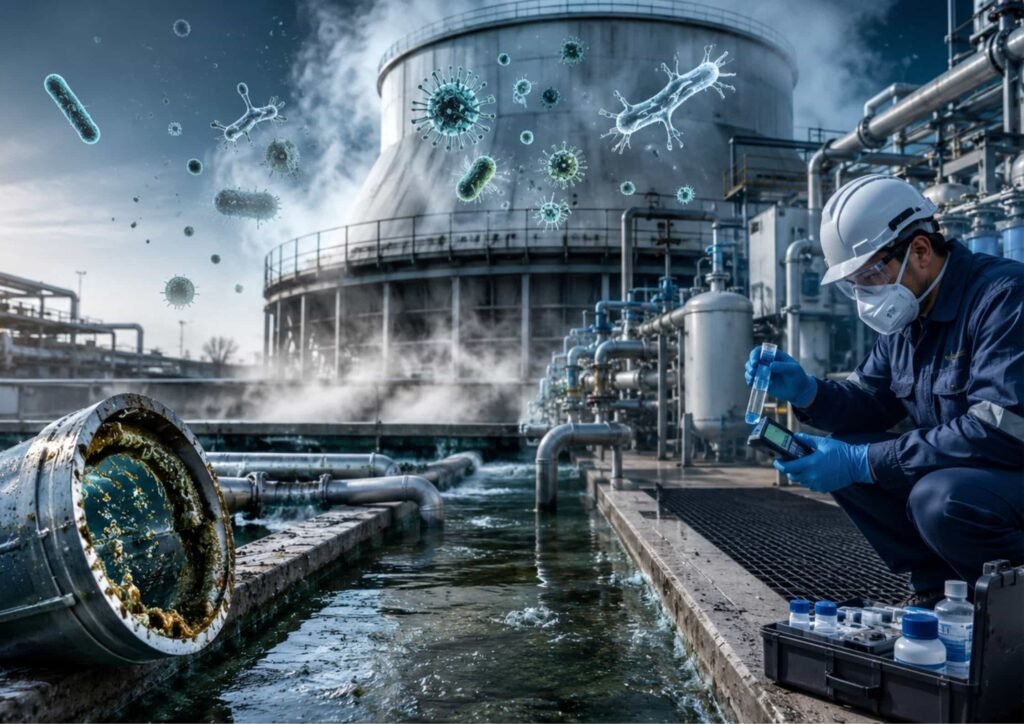
Cooling towers create near-perfect conditions for microbial growth. Water temperatures typically run between 70 and 120 degrees Fahrenheit, which is exactly where bacteria, algae, and fungi thrive. Water is aerosolized and circulated continuously, which moves microorganisms throughout the system. Airborne debris, nutrients from the environment, and sunlight penetrating open basins all feed biological growth.
Biofilms are the real problem. Individual bacteria in open water are relatively easy to kill with standard biocides. But biofilms, the thick, organized colonies that establish themselves on fill media and basin surfaces, are a different challenge. Bacteria inside a mature biofilm can require biocide concentrations 1,000 times higher to achieve the same kill as free-floating cells.
Legionella: The Risk You Cannot Afford to Underestimate
Legionella pneumophila is the bacterium responsible for Legionnaires’ disease, a serious and potentially fatal form of pneumonia. Cooling towers are the most commonly implicated source in community outbreaks because they generate the fine aerosol droplets that carry Legionella into the air and into building ventilation.
The growth range for Legionella is 77 to 113 degrees Fahrenheit (25 to 45 degrees Celsius), which overlaps almost exactly with normal cooling tower operating temperatures. Stagnant water, scale deposits (which protect bacteria from biocides), and low biocide residuals all dramatically increase Legionella risk.
Regulatory Requirements: ASHRAE 188 and OSHA
ASHRAE Standard 188-2021 sets the national benchmark for Legionella risk management in building water systems in the United States. It requires facilities with cooling towers to develop and implement a Water Management Plan (WMP) that includes hazard analysis, control measures, monitoring, corrective actions, and documentation.
OSHA does not have a specific Legionella standard, but enforcement actions have been taken under the General Duty Clause when employers fail to protect workers from known Legionella hazards. Facilities that have experienced Legionella outbreaks have faced fines, civil liability, and in some cases, criminal charges against individual managers.
Several major U.S. cities and states have enacted their own Legionella ordinances that go beyond ASHRAE 188. New York City’s Local Law 77 requires annual registration, quarterly testing, and documented Water Management Plans for all cooling towers. Similar regulations are spreading to other jurisdictions.
What a Proper Biocide Program Looks Like
- Oxidizing biocides (chlorine, bromine, chlorine dioxide) provide fast kill of free-floating bacteria
- Non-oxidizing biocides (isothiazolinones, quaternary ammonium compounds, glutaraldehyde) penetrate biofilms more effectively
- Alternating between two different non-oxidizing biocides prevents resistance development
- Biocide contact time and concentration must be carefully managed, documented, and verified
- Drift eliminators with efficiency ratings of 0.0005 percent or better are now standard for Legionella control
Detection: What to Look For
- Slimy, slippery surfaces on fill media and basin walls
- Green or brown growth visible in the water or on surfaces
- Foul, musty odors from the system
- Cloudy or discolored water that does not clear after treatment
- Positive Legionella culture results from water sampling (quarterly sampling is recommended minimum)
Real-World Example: Hospital System in Illinois
A regional hospital network in the Chicago area implemented a comprehensive Water Management Plan across all three of their campuses in 2021 following ASHRAE 188. Within the first year, they documented a 94 percent reduction in Legionella-positive water samples and eliminated two Legionella-related patient notifications that had previously occurred annually. Their legal team estimated the program saved over $3 million in potential liability exposure in its first 24 months.
Risk 4: Mechanical Failures
Why Mechanical Problems Hit Hardest
Mechanical failures are the most immediately disruptive of the four risks. When a fan motor seizes or a gearbox fails, you do not get a gradual performance decline. You get a full shutdown, often in the middle of a production run, often at the worst possible time.
Cooling tower mechanical components operate in a demanding environment. Fans run continuously in humid, corrosive air. Motors bear heavy loads through temperature swings from subfreezing to over 100 degrees. Drive belts age and crack. Bearings run dry when lubrication intervals are missed. None of this is unusual, but it all requires a disciplined maintenance program to stay ahead of.
Common Mechanical Failure Mechanisms
- Inadequate or incorrect lubrication leading to bearing failure is the single most common mechanical failure in cooling towers
- Fan blade imbalance is causing vibration that accelerates bearing and shaft wear
- Misalignment between the motor and drive shaft creates oscillating stresses
- Belt deterioration from UV exposure, chemical attack, or improper tension
- Electrical faults in motors caused by moisture infiltration into terminal boxes
- Gearbox oil contamination leading to accelerated gear wear
Early Warning Signs to Monitor
- Grinding, squealing, or rattling sounds that were not present before
- Vibration readings above baseline on motors, bearings, or the fan deck structure
- Motor amperage running higher than the normal nameplate current
- Gearbox oil that is discolored, milky, or contains metal particles
- Visible cracks or chips on fan blades
Mechanical Maintenance Best Practices
Vibration analysis is now considered a baseline practice for any facility with cooling towers above a certain size. Handheld vibration meters are inexpensive and give you a fast snapshot of bearing condition. Portable data collectors and trend analysis software give you a longer-term picture that catches problems months before they become failures.
Lubrication must follow the manufacturer’s schedule by operating hours, not just calendar time. Over-greasing is as destructive as under-greasing. Automated lubrication systems eliminate the human error factor almost entirely and are worth considering for hard-to-access bearings.
Belt tension should be checked every 90 days and adjusted according to manufacturer’s specifications. Belts that are too tight cause bearing overload. Belts that are too loose slip and overheat. Most modern cooling tower installations now use direct-drive configurations that eliminate belt maintenance.
Fan blade inspection should be part of every annual shutdown. Composite fan blades can develop delamination or cracking that is not visible during normal operation. Any blade that shows cracking, delamination, or has taken a significant impact should be replaced, not repaired.
Real-World Example: Food Processing Facility in California
A large food processing operation in Fresno, California, implemented a monthly vibration monitoring program across all eight of their cooling tower fan motors in 2022. In the first 18 months, they caught two bearing failures at an early stage, before any damage had propagated to the motor or shaft. Total repair cost for both incidents: under $4,000. They estimate a full motor replacement plus associated downtime would have cost $60,000 or more per incident.
The True Cost of Cooling Tower Neglect in 2026
The numbers are not hypothetical. They come from actual loss data compiled by risk management firms, insurance underwriters, and facility maintenance organizations across the country.
| Cost Category | Typical Range | Notes |
| Emergency repair premium | 200 to 400% above standard rates | Parts procurement becomes urgent and non-negotiable |
| Manufacturing downtime | $30,000 to $50,000 per hour | Based on mid-size industrial facility averages |
| Data center downtime | Up to $540,000 per hour | Uptime Institute 2023 benchmark data |
| Legionella settlement costs | $1M to $25M+ | Based on U.S. litigation outcomes since 2015 |
| Energy waste from scaling | 15 to 30% increase | Proportional to the degree of heat transfer efficiency loss |
| OSHA fines for violations | $15,625 per violation | Up to $156,259 for willful violations as of 2024 |
The math is clear. A proactive maintenance program that costs $30,000 to $80,000 per year for a mid-size industrial cooling tower system is a fraction of what a single emergency event can cost. The economics of prevention are not even close.
Strategic Prevention: Building a Program That Actually Works
The Inspection Schedule That Covers All Four Risks
| Frequency | Tasks to Complete | Who Should Do It |
| Daily | Visual check of water clarity, color, and odor. Review chemical feed system operation. Check for unusual noises. | Trained facility staff |
| Weekly | Measure pH, conductivity, and biocide residual. Inspect nozzles and distribution. Record all readings. | Water treatment technician |
| Monthly | Deep clean and disinfection. Mechanical inspection and lubrication check. Vibration baseline reading. Basin inspection. | Maintenance team plus vendor |
| Quarterly | Legionella water sampling. Coupon rack pull for corrosion rate analysis. Fill media inspection. | Certified testing laboratory |
| Annually | Full structural assessment. Fan blade inspection. Heat transfer efficiency test. Complete system cleaning and disinfection. | Qualified engineering firm |
Water Treatment: The Foundation of Everything Else
A cooling tower without a properly designed and managed water treatment program is not a matter of if it will develop problems; it is a matter of when. Every chemical product, every dosage, every control setpoint must be matched to your specific system: its metallurgy, its operating conditions, your local water chemistry, and your regulatory requirements.
Work with a water treatment company that provides service visits, not just chemical deliveries. A competent water treatment vendor will write a formal treatment program, establish clear control parameters, visit the site regularly to verify that those parameters are being met, and document everything. That documentation is also your evidence of due diligence if a regulatory agency ever knocks on your door.
For Legionella compliance specifically, your water treatment vendor should be familiar with ASHRAE 188 requirements and should help you develop or audit your Water Management Plan.
When to Repair vs. Replace: Making the Right Call
This is the question that comes up most often in aging systems. There is no universal answer, but there is a framework that works.
If the system is under 15 years old, structurally sound, and the specific failure is isolated, repair almost always makes more financial sense. If the system is over 20 years old, is experiencing repeated failures across multiple components, and efficiency has degraded significantly, a lifecycle cost analysis comparing repair costs over the next five years against replacement cost plus improved efficiency usually points toward replacement.
A detailed cooling tower repair versus replacement ROI analysis, done by a qualified engineer, is worth the investment. A few thousand dollars spent on that analysis can save hundreds of thousands in the wrong decision.
Common Misconceptions That Cost Facilities Money
Misconception 1: If the tower is still running, it is still working
A cooling tower that is running is not necessarily a cooling tower that is performing. Efficiency losses from scaling and fouling are gradual and invisible from the outside. By the time most operators notice a problem through higher utility bills or reduced process cooling, the system has often been underperforming for months.
Misconception 2: Chemical treatment is optional if the water looks clean
Visual clarity is not a measure of water quality in a cooling tower. Legionella colonies are invisible to the naked eye. Corrosive conditions cannot be seen without water testing. Scale can form in areas you cannot inspect without taking the system offline. Regular chemical testing is not optional; it is the only way to know what is actually happening in your water.
Misconception 3: Annual cleaning is enough for Legionella control
Annual cleaning is of the floor, not the ceiling. ASHRAE 188 and most regulatory guidelines that have adopted it require ongoing monitoring, regular biocide treatment, and documented Water Management Plans. Annual cleaning alone does not satisfy these requirements and does not adequately control Legionella risk in a system that operates year-round.
What Is Changing in Cooling Tower Management: 2026 and Beyond
The biggest shift happening right now is the move toward continuous, sensor-based monitoring. IoT-connected sensors now give facility managers real-time visibility into water quality parameters, flow rates, chemical concentrations, vibration levels, and power consumption, all accessible from a smartphone or a building management system dashboard.
Early adopters of these systems are reporting 20 to 40 percent reductions in unplanned downtime events and chemical consumption savings of 10 to 25 percent through tighter control. Several major water treatment companies now offer cloud-connected monitoring platforms as part of their service contracts.
On the regulatory side, Legionella requirements are expanding. More U.S. cities and states are moving toward mandatory Water Management Plans, annual registration, and quarterly Legionella testing requirements. Facilities that already have robust programs in place will adapt easily. Those who have been managing reactively will face a significant compliance burden.
Water conservation pressures are also reshaping how cooling towers are operated. As water costs rise and some municipalities introduce cooling tower water use restrictions, optimizing cycles of concentration to reduce blowdown frequency is becoming both an economic and regulatory priority.
What You Should Do Starting This Week
I have spent over 30 years watching facilities make the same preventable mistakes with cooling towers. The systems that stay in service longest and cost the least to operate are not the ones with the newest equipment. They are the ones managed by people who pay attention consistently, inspect regularly, treat the water properly, and fix small problems before they become large ones.
You do not need a massive budget to do this well. You need a documented program, a reliable water treatment vendor, a mechanical maintenance schedule that is actually followed, and someone who reads the data and acts on it.
If you are not sure where your system stands today, start with a third-party cooling tower assessment. A qualified engineer can inspect your structural condition, review your water treatment records, evaluate your mechanical maintenance history, and give you a clear picture of where you are and what you need to do. That assessment is the best investment most facilities can make in their cooling infrastructure.
The facilities that treat cooling tower maintenance as a cost are the ones that end up paying the most. The ones that treat it as protection for their production capacity, their people, and their assets are the ones that stay competitive.
Contact a qualified cooling tower engineer or water treatment specialist today to schedule an assessment of your system.
FAQ’s
How often should cooling tower water be tested?
At a minimum, pH, conductivity, and biocide residual should be checked weekly. Legionella sampling is recommended quarterly as a minimum under most current guidelines.
Corrosion coupons should be analyzed quarterly. Full microbiological culture testing, including heterotrophic plate counts, should be done at least semi-annually.
What water temperature range promotes Legionella growth in cooling towers?
Legionella pneumophila grows most actively between 77 and 113 degrees Fahrenheit (25 to 45 degrees Celsius). This overlaps with the operating temperature of most cooling tower return water.
What does it cost to clean and treat a cooling tower?
Costs vary widely by system size and condition. A routine annual cleaning and disinfection for a mid-size industrial cooling tower typically runs between $5,000 and $25,000. Full chemical descaling of a severely scaled system can run $20,000 to $75,000 or more. Emergency cleaning following a Legionella event often costs $50,000 to $200,000
How do I know if my cooling tower needs repair or full replacement?
The answer depends on the age of the system, the extent of structural deterioration, the history of repeated failures, and a lifecycle cost analysis. Systems under 15 years old with isolated failures are always for targeted repair. Systems over 20 years old with widespread corrosion, repeated mechanical failures, often show a better return on investment from replacement.
Does ASHRAE 188 apply to my facility?
ASHRAE Standard 188-2021 applies to building water systems in facilities subject to certain occupancy and complexity thresholds. Many states and municipalities have adopted or referenced ASHRAE 188 in their local regulations, making it effectively mandatory even where it is not specifically cited by law.
What is the approach temperature and why does it matter?
Approach temperature is the difference between the temperature of the cooled water leaving the tower and the ambient wet-bulb temperature.
Read More : The Future Beyond Smartphones Is Already Here: Tech Giants Envision