
What Is the King Cheesecake Recall?
Has this ever happened to you? One day, you go to a bakery and buy your favorite cheesecake—maybe a carrot layer cake or a tres leches cheesecake—and suddenly, food safety authorities tell you to throw it away.
If not, let me tell you—something like this actually happened in July 2025, when King Cheesecake Company, Inc. of Houston, Texas, recalled six of its ready-to-eat cakes.
Reason: After internal testing flagged a serious problem, the pecans used in these cakes had the potential to be contaminated with Salmonella.
The U.S. Food and Drug Administration (FDA) classified this as a Class I recall on August 7, 2025. That is the highest risk level the FDA issues. It means the product could cause serious illness or death.
As of April 2026, no confirmed illnesses have been linked to this recall. But the products remain under recall and should not be consumed.
What Caused the King Cheesecake Recall?
The recall started with the pecans, not the cakes.
On August 1, 2025, Navarro Pecan Holdings of Corsicana, Texas, recalled 32,670 pounds of pecan products due to potential Salmonella contamination. Those pecans were distributed across five US states and three countries.
King Cheesecake Company used pecans in several of its products. After internal testing flagged a risk, the company voluntarily recalled six products on July 18, 2025. The FDA reviewed the recall and assigned it Class I status on August 7, 2025.
This is how the food safety system is supposed to work: a company tests its ingredients, finds a potential risk, and acts before consumers get sick.
The recall also shows why supplier oversight matters. A contamination problem at one pecan company in Texas triggered recalls affecting products sold across six states. Food manufacturers cannot only test their finished products. They need to verify the safety of every ingredient they source.
King Cheesecake Recall: Full Product List
The following six products are covered under this recall. All were manufactured between June 20 and July 14, 2025.
| Product Name | Item Number | Manufacture Dates |
| Italian Layer Cake | 1071 | June 20 to July 14, 2025 |
| Carrot Layer Cake | 1312 | June 20 to July 14, 2025 |
| Tres Leches Cheesecake | 99272 | June 20 to July 14, 2025 |
| Hummingbird Layer Cake | 3145 | June 20 to July 14, 2025 |
| Chocolate Tres Leches Cheesecake | 99273 | June 20 to July 14, 2025 |
| Assorted Layer Cake | 2485 | June 20 to July 14, 2025 |
Source: FDA Enforcement Report, Event ID 97299
Check the item number on your packaging against the numbers above. If it matches and the product was made between those dates, it is part of the recall. Do not eat it!!
Which States Were Affected?
The recalled products were distributed to six US states. If you live in any of these areas and bought layered cakes or cheesecakes between late June and mid-July 2025, check your packaging now.
| State | Distribution Confirmed |
| Texas | Yes |
| Louisiana | Yes |
| Oklahoma | Yes |
| Florida | Yes |
| Illinois | Yes |
| Alabama | Yes |
Note: One source also lists Arkansas. If you are in Arkansas, treat this recall as applicable until the FDA confirms otherwise.
Even if you are outside these states, it is worth checking your fridge. Food products can travel through supply chains and retail distributors in ways that go beyond the originally listed states.
What Salmonella Does To Your Body?
Salmonella causes an illness called salmonellosis. Symptoms usually appear 12 to 72 hours after eating contaminated food. They include,
- Diarrhea
- Fever
- Stomach cramps.
Most people recover within four to seven days without treatment.
For some people, it is much more serious. These groups face a higher risk of severe illness:
- Children under five years old
- Adults over 65
- Pregnant women
- People with weakened immune systems, including those going through chemotherapy or living with a chronic illness
In serious cases, Salmonella spreads from the intestines into the bloodstream and can reach other organs. Around 450 Americans die from salmonellosis each year. Nationally, Salmonella causes about 1.35 million infections and roughly 26,500 hospitalizations per year in the US.
Salmonella has no smell and leaves no visible signs on food. You cannot tell if a product is contaminated by looking at it or smelling it. That is why the FDA issues recalls even when no illnesses have been confirmed.
Note:
IF YOU ARE IN A HIGH-RISK GROUP and have eaten any recalled King Cheesecake product, contact your doctor right away. Do not wait for symptoms to develop.
What To Do If You Have a Recalled Product
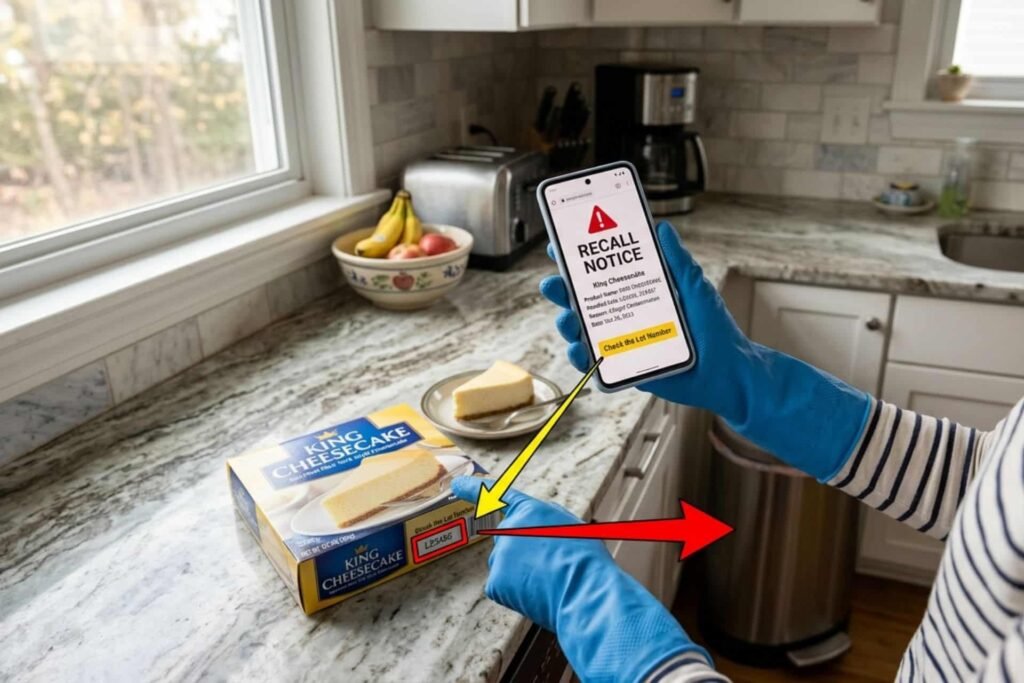
Step 1: Check your kitchen now
Look for the product names and item numbers listed in the table above. Check your fridge, freezer, and any storage area where you keep purchased desserts.
Step 2: Do not eat it
Even if it looks and smells normal. Even if only part of the product has been eaten. Set it aside immediately.
Step 3: Dispose of it safely
Seal the product in a plastic bag before throwing it away. This stops bacteria from spreading to other surfaces or to other people in your household.
Step 4: Clean any surfaces it touched
Wash fridge shelves, plates, cutting boards, and utensils that touched the product with hot, soapy water. Salmonella can survive on surfaces and cause what is called cross-contamination.
Step 5: Return it for a full refund
Most stores will give you a full refund for recalled items. You usually do not need a receipt. Contact the store where you bought the product directly.
Step 6: Watch for symptoms
If you have already eaten the product, watch for symptoms (diarrhea, fever, stomach cramps) in the 12 to 72 hours that follow. If you are in a high-risk group, call your doctor now rather than waiting.
What Experts and Regulators Are Saying
“Salmonella sends thousands to the hospital every year and can be deadly, especially for the most vulnerable: young children, the elderly, and those with weakened immune systems.”
(Darin Detwiler, Food Safety Expert, Northeastern University)
“A Class I recall means a reasonable probability that using or being exposed to this product will cause serious adverse health consequences or death.”
(U.S. Food and Drug Administration)
Food safety expert Darin Detwiler, a professor at Northeastern University and adviser to the Alliance for Recall Ready Communities, has consistently highlighted that Salmonella is underestimated as a public health threat. His point is backed by CDC data: for every confirmed Salmonella case, an estimated 29 additional cases go undetected.
Why the King Cheesecake Recall Matters for Food Safety
The King Cheesecake recall is one of dozens of Salmonella-related recalls that happen in the US every year. According to the PIRG Education Fund’s Food for Thought 2025 report, there were 41 Salmonella recalls in 2024 alone. That is up from 27 in 2023 and just 21 in 2019.
Foodborne illness is a serious public health issue in the US. The CDC estimates that 1 in 6 Americans gets sick from contaminated food or beverages every year. That is roughly 48 million people. Of those, about 128,000 end up in the hospital, and 3,000 die.
In 2024, hospitalizations from recalled food more than doubled compared to 2023, rising from 230 to 487. The data shows that while the number of recalls has stayed relatively stable, the severity of cases has increased.
Recalls like the King Cheesecake case are part of a system designed to catch problems before they become outbreaks. When that system works quickly, as it did here, serious illness can be prevented.
Common Misconceptions About This Recall
Misconception 1.
No confirmed illnesses means no real risk.
Reality
Not true. The FDA assigned Class I status based on confirmed contamination risk found through testing, not illness reports. The absence of confirmed cases likely means the recall moved fast enough to prevent widespread illness.
Misconception 2
Only cheesecakes are affected.
Reality
No. Four of the six recalled products are layer cakes. All six contain pecans and fall under the same recall. Check all six product names in the table above.
Misconception 3
Heating the cake will make it safe.
Reality
These are ready-to-eat desserts, not designed to be cooked. Partial reheating does not reliably eliminate Salmonella embedded in pecan pieces inside a cake. Follow the FDA guidance: do not eat it.
Misconception 4
This recall only matters if you live in Texas.
Reality
Distribution was confirmed across six states. Consumers in Alabama, Florida, Illinois, Louisiana, Oklahoma, and Texas all need to check their kitchens.
How Countries Handle Pecan And Nut-Related Food Recalls
One contaminated pecan supplier in Texas triggered recalls across six US states. Here is how four major food safety systems would respond to the same event.
United States
The FDA’s FSMA rules require manufacturers to test ingredients and verify suppliers before products ship. King Cheesecake caught the risk internally — exactly how the system is designed to work. The FDA published the Class I recall on August 7 2025.
Canada
The CFIA mirrors FDA risk classifications and coordinates closely with US agencies. Any flagged US pecan shipment can trigger an immediate CFIA review.
United Kingdom
The UK FSA uses the same Class I/II hierarchy and maintains a public recall database. Post-Brexit, the UK now handles US import alerts separately from the EU.
European Union
The EU’s RASFF system sends one alert that instantly covers all 27 member states. It is the most coordinated recall network in the world.
What Developing Countries Can Learn From This Recall
For developing countries with less robust food safety infrastructure, the King Cheesecake recall offers a useful lesson: voluntary recall systems work best when companies conduct proactive internal testing rather than waiting for illness reports. Supplier auditing programs, pathogen testing of incoming ingredients, and clear recall communication protocols are the practical mechanisms that prevent community illness.
Future Perspective: 3 Big Shifts in US Food Safety
1. Testing Moves Upstream
The FDA’s Foreign Supplier Verification Platform pushes companies to test raw ingredients — not just finished products. Real-time pathogen detection at the ingredient level is the next frontier.
2. Direct Consumer Alerts Are Coming
The PIRG Food For Thought 2025 Report recommended direct email and text alerts for every Class I recall. Federal legislation to make this standard is gaining traction.
3. Traceability Becomes Law
The FDA Food Traceability Rule — rolling out through 2026 — requires high-risk food producers to trace contaminated products to their source within hours. Narrower recalls. Faster action.
Five Practical Food Safety Tips for US Consumers
- Sign up for FDA recall alerts. You can get email notifications for Class I alerts sent directly to your inbox.
- Check labels on any pecan-containing dessert you bought in the summer of 2025, especially if you live in one of the six affected states.
- When in doubt, throw it out. No visual check replaces proper product testing.
- Store ready-to-eat desserts at or below 40 degrees Fahrenheit and consume them before the use-by date.
- Report a suspected illness to the FDAMedWatch program and your local health department. Your report helps investigators identify outbreak patterns faster.
Final Thoughts
The King Cheesecake recall shows how quickly a problem in one ingredient can travel through the food supply. A pecan company in Corsicana, Texas, triggered a chain of recalls that put consumers in six states at risk.
The system responded well. The King Cheesecake Company acted before anyone reported getting sick. The FDA reviewed and published the recall within weeks. That is the food safety process working as it should.
But the system only works when consumers act on the information. Check the product list. Check your kitchen. Follow the six steps above if you find a recalled item. And sign up for FDA alerts so you hear about the next recall before it reaches your table.
WHAT YOU SHOULD DO NEXT: If you are in Alabama, Florida, Illinois, Louisiana, Oklahoma, or Texas and bought a layered cake or cheesecake between June and August 2025, check the item number against the list in this article. For the latest updates, visit:fda.gov/safety/recalls-market-withdrawals-safety-alerts
Read More : What Is Duaction? The Teaching Method Raising Graduation Rates by 11%
FAQ’s
How do I know if my product is recalled?
Check the item number on your packaging against these six numbers: 1071, 1312, 99272, 3145, 99273, and 2485. If it matches and was made between June 20 and July 14, 2025, it is part of the recall.
What if I already ate the product?
Watch for symptoms within 72 hours: diarrhea, fever, and stomach cramps. If you are in a high-risk group (young children, older adults, pregnant women, or people with weakened immune systems), contact your doctor now.
Were any people confirmed sick from this recall?
As of February 2026, no confirmed illnesses were linked to this recall, according to the FDA enforcement record. Check the FDA GOV for the latest updates, as this status can change.
Can I get a refund?
Yes. Return the product to the store where you bought it. Most retailers offer a full refund for recalled items, with or without a receipt.
Is this connected to other pecan recalls in 2025?
Yes. Navarro Pecan Holdings of Corsicana, Texas, also issued a Class I recall on August 1, 2025, covering 32,670 pounds of pecan products distributed across five US states and three countries. The King Cheesecake recall is a direct downstream result of that supply chain event.