

AI is evolving day by day—now and then, a new model is launched, better than the previous one.
No one! literally no one! Can say that we don’t use artificial intelligence. Whether you are a student, teacher, doctor, patient, writer, or business owner, AI is involved in every aspect of your life.
No doubt, it’s a powerful technology, but there is a hidden cost behind its power. And that cost is— its impact on our environment. With that, we often ask ourselves a question: How bad is AI for the environment? The answer to it is not that simple.
Yes!
It offers solutions to our problems, but at the same time, it creates new ones—so, to understand its environmental impact, we must look at both the energy it consumes and the promises it holds.
In this blog, we will discuss both the negative impact of AI on our environment and how we can mitigate it.
What is Artificial Intelligence?
Artificial Intelligence is a branch of computer science. It creates machines that perform tasks that require human intelligence.
This includes learning, problem-solving, and recognizing patterns. Machine learning is a key part of AI. It uses algorithms to analyze large amounts of data sets and learns from them without being explicitly programmed for every task. This learning process makes it a powerful and energy-intensive tool.
Negative Impact Of AI On Our Environment
Carbon Emission
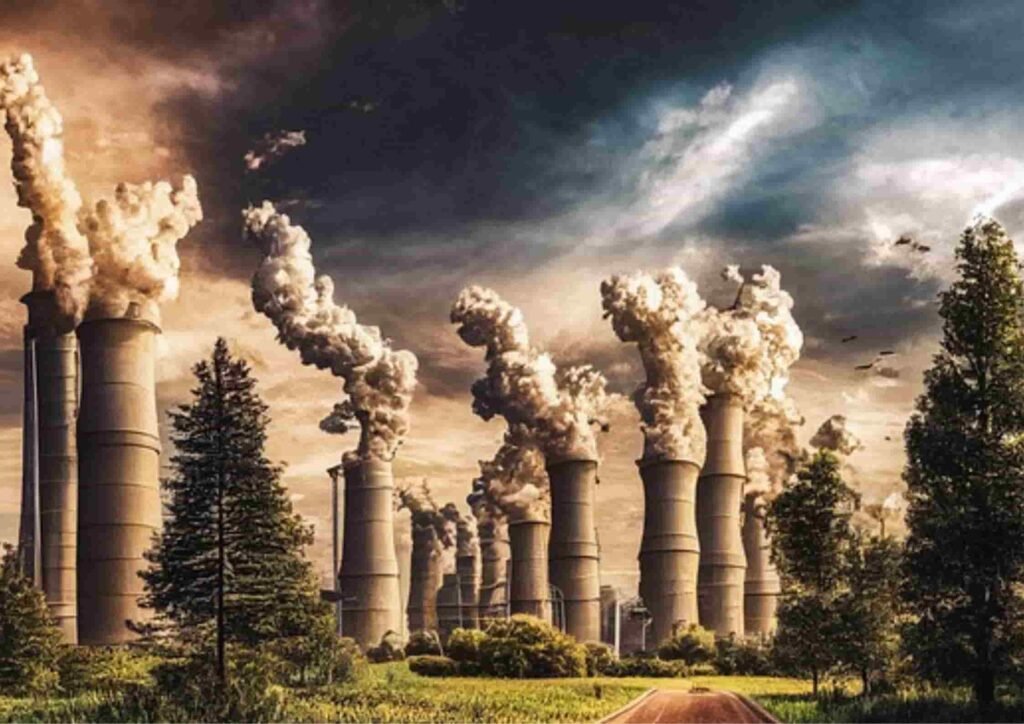
To know how bad AI is for the environment? We must look at its carbon footprint first. AI models (like ChatGPT, Gemini, and DeepSeek) require huge centers and computers for their training and running. These data centers consume a significant amount of electricity. The fact of the matter is, they run 24/7. They require energy for mainly two purposes,
- For running and training
- And for their cooling
Studies have shown that a single large AI model can emit over 626,000 pounds of carbon dioxide. This is the same as the lifetime emissions of five average cars.
The International Energy Agency (IEA) warns that the electricity consumption by AI centers could double by 2026. Since most of the power plants produce electricity by burning fossil fuels, this directly contributes to greenhouse gas emissions.
This creates a troubling cycle—a system designed to control climate crises, but in reality, most of the crisis is created by this system. So, how bad is AI for the environment? Its energy appetite is a core part of the problem.
The Role Of Renewable Energy

The solution to this problem is the use of renewable energy sources.
We must produce electricity from resources that are renewable and never run out.
Renewable sources include
- Water (Hydroelectricity)
- Sunlight ( Solar energy)
- Wing (Wind energy)
Many countries are shifting towards these resources, but a 100% shift will take some time.
Countries Producing Clean Energy
- United States
- Most of the Google offices are located near renewable sources.
- Tech Giants like Microsoft, Google, and Amazon are making heavy Power Purchase Agreements (PPAs) for renewables to cover their energy needs.
- Iceland
- 90-98% of its energy comes from Geothermal power plants and Hydropower plants
- Norway
- Runs on virtually 100% Hydro and Wind electricity
- Sweden
- Same as Norway, its energy comes from Hydro, Nuclear, and wind power plants.
- Germany
- A Global pioneer in energy transition.
- It still uses fossil fuels for energy production, about 50%. And the remaining 50% comes from Wind and solar power houses.
These are a few examples. Almost every country in the world has made huge investments in renewable energy production.
AI’s Thirst: Hidden Water Cost

As we have discussed earlier, AI is maintained in big data centers. In addition to their energy needs, they require 24/7 heavy cooling machines. Because their powerful computers produce heat if left unchecked, they will destroy the equipment.
These cooling machines use evaporative cooling techniques, which consume millions of gallons of water every day. Consume millions of gallons of water every day. Because they use evaporating cooling
Water is our basic need. Our agriculture, food production, and livestock all depend on water.
According to the UN World Water Development report in 2023, there is a decline of about 20% in global per-capita internal renewable freshwater resources.
And AI water needs are putting more pressure on local water supplies.
Isn’t it ironic! The technology of the future is competing with the basic needs of humanity.
Solutions To Reduce AI’s Massive Water Consumption
- Companies should use water-efficient cooling systems, such as liquid immersion or recycled wastewater cooling, for their data centers
- Tech Giants like Microsoft and Google are testing these methods to cut water use.
- Locating data centers in cooler climates or near renewable energy and seawater sources can further reduce their freshwater demand.
Mining Of Rare Earth Metals

Lithium, cobalt, and copper are essential for the batteries and processors that power AI. Extracting these minerals from the earth is a destructive process.
Mining operations often involve clearing vast areas of land, leading to forest and habitat destruction. This directly results in a loss of biodiversity.
Furthermore, these mining operations disrupt local communities. Because mines are built where Tribal people live. They are displaced from their ancestral lands to make way for new homesteads.
Hence, progress in technology advances society, but it also damages the environment and creates social issues.
Now!
How bad is AI for the environment? The damage caused by mining for its components is also a part of our calculation.
Accountability Challenges
One of the hurdles in addressing this environmental crisis is the lack of clear and consistent measurement of its impact. Therefore, how can we manage what we cannot measure? Right now, there is no universal standard for calculating the carbon or water footprint of an AI model.
And the hardest part is, different companies use different parameters to measure their effects.
You may find this article valuable: Top 5 AI Detectors for Evaluating Student Work in 2025
Yale’s Research On AI’s Environmental Impact

Professor Yuan Yao from the Yale School of the Environment is working to solve this problem. She is part of a team that is focused on developing effective methods to measure AI’s environmental impacts.
As she said,
“We need systems and techniques that can accurately measure AI’s environmental impacts”.
Until we have a clear way to track these costs, efforts to reduce them will be less effective.
So,
How bad is AI for the environment? Right now, we don’t have a proper technique to measure its effects, which itself is a problem.
But if we take the right steps to consider the safety of our environment first, we can minimize its effects in the near future.
Final Thoughts

The question “How bad is AI for the environment?” does not have an answer in yes or no answer. Its carbon footprint, massive water consumption, and need to mine rare earth metals for its hardware components are clearly visible and cannot be ignored. They present serious challenges that can reduce their benefits.
We can minimize its influence if we use clean energy. Clean energy can be obtained,
- By replacing non-renewable energy resources with renewable energy resources
- Use a water-efficient cooling system.
- Adopting safe mining practices.
- Making sure that the land is restored after
the extraction
- Using recycled computer chips can reduce the need for new mining.
Apart from this, AI also offers tools to combat climate change and protect nature. The key is to use this technology with mindfulness.
AI is our future need, but steps should be taken to minimize the harm it creates. This responsibility lies on the shoulders of tech companies, policymakers, and researchers to ensure this technology doesn’t backfire.
So, again!
How bad is AI for the environment? Ultimately, the answer depends on the choices we make today.
FAQ’s
Is any AI is environment friendly ?
Green AI is more environmentally friendly than conventional AI
which country is No1 in AI ?
The U.S. possesses the strongest AI ecosystem globally, outperforming every other country by a wide margin.While China tops the world with 230 AI clusters, the United States holds a commanding 50% share of global AI compute power, according to a new report by TRG Datacenters.